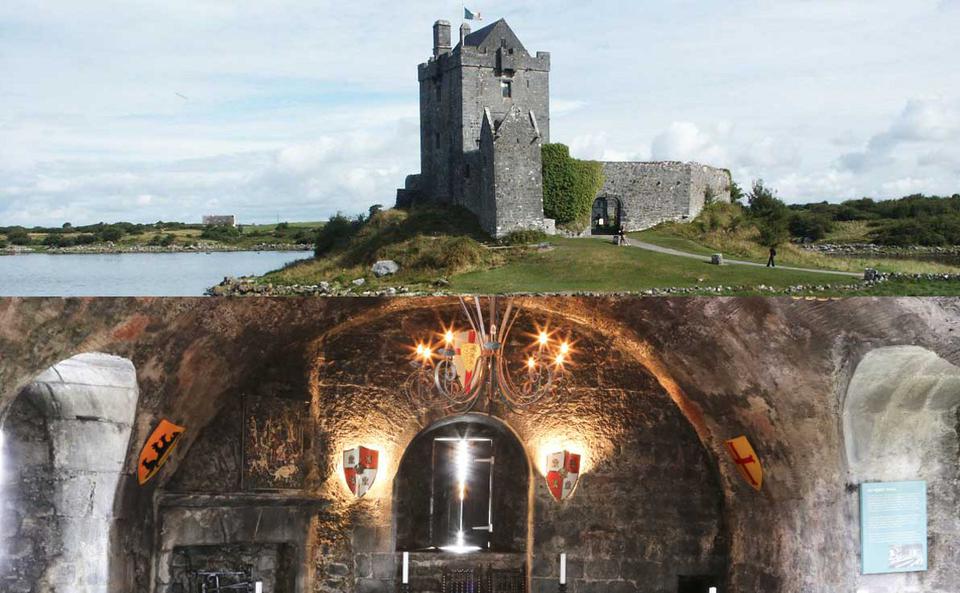
Add your own picture and explain the route, parking, gates, paths or landmarks that help people find it.
Earn 5 points after the picture is checked and accepted.
Add your photo and local directionsShare what you foundWhat is recorded here
On top of a motte and bailey (GA016-056001-). In existence in 1574 when it was in the possession of 'Thomas Balve' (Nolan 1901b, 117). According to Neary (1914, 124, no. 150), the remains of the castle comprised 'Nine huge blocks of masonry strewn around and upwards of ten tons each [which] have kept together with wonderful cohesion. Tradition says the binding material was a compost of animal blood, sand and lime. The state of the ruin suggests that it was blown up'. Several large chunks of uncoursed mortared limestone masonry still lie about the top of the motte. No architectural features survive. Slight undulations in the ground surface may be grassed-over footings of the castle walls. Neary (ibid.) also refers to a rectangular 'subsidiary building 20 ft. lower down on N', and to 'an opening to a souterrain in the centre of the castle': no visible surface trace of these survive; the latter is unlikely to be a souterrain. He also mentions the existence of a 'picture' (probably a painting) of the castle which showed it to be 'as massive as Dunmore' (see GA017-069----)
The above description is derived from the published 'Archaeological Inventory of County Galway Vol. II - North Galway'. Compiled by Olive Alcock, Kathy de hÓra and Paul Gosling (Dublin: Stationery Office, 1999).
Date of upload: 05 August 2010
The monument record does not grant public access. Check the route and ask the landowner before entering private land.