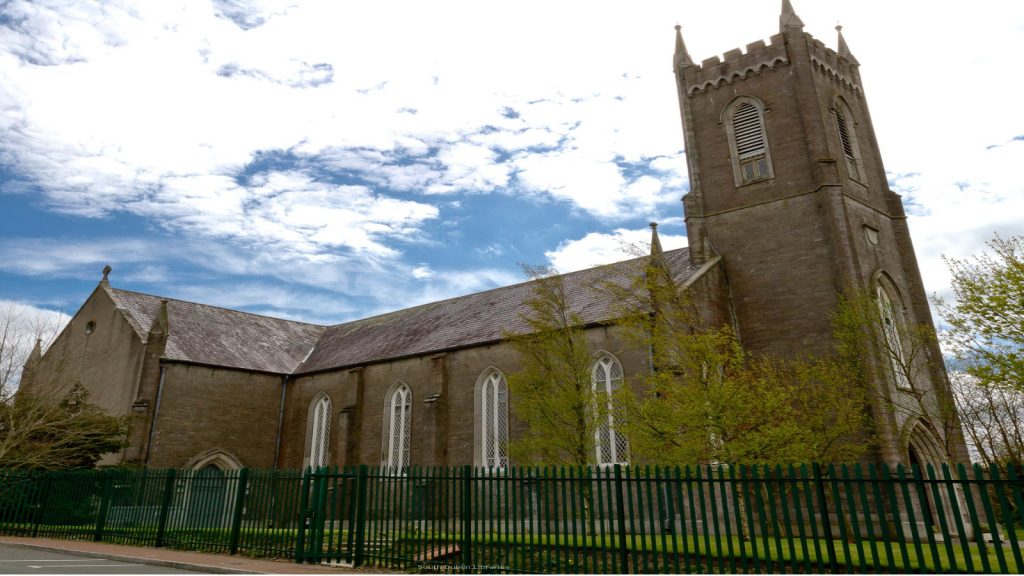
Add your own picture and explain the route, parking, gates, paths or landmarks that help people find it.
Earn 5 points after the picture is checked and accepted.
Add your photo and local directionsShare what you foundWhat is recorded here
Site of the medieval church of Saggart (Teach Sagard) dedicated to the 7th-century St Moshagra stands in the centre of a roughly circular-shaped graveyard (DU021-034003-) to the N of the village of Saggart. D'alton (1838, 721) recorded that; 'This parish constitutes a prebend in St. Patrick's church [DU018-020269-], of the annual value of £163, the rectory being part of its corps; the curacy is in the gift of the archbishop. The great tithes belong to the Dean of St. Patrick's, and there are 24a. of glebe within the parish. Immediately subsequent to the English invasion Saggard be came, as before - mentioned, one of the four royal manors in this county, and was more commonly called Teagh Saggard'. The chapel of Newtown (DU024-001001-) within the manor of Rathcoole and the chapel of Symon-Tallaght (DU021-042----) were both daughter chapels to the mother church of Saggart (Mason 1820, 60). In 1275 the church of Saggart was worth £20 per annum to the incumbent (Mason 1820, 59). The 1302-07 Ecclesiastical Taxation of the See of Dublin valued the 'Prebend of Tassagard' at £10 per annum with the tithe valued at 20s. (Cal. doc. Ire. vol. V, 237). An inquisition of 1547 finds the extent and value of the prebend of Tassagard, in lands and tithes, exclusive of the altarages, which were assigned to the curate, and the repair of the chancel, which was borne by the farmer of the tithes. The glebe lands have been since ascertained to be 16a. 1r. 4p. Another inquisition of the same date shows that the vicars choral of St. Patrick's had one castle and 22a. in this townland, lying in different parcels' (D'Alton 1838, 723).
In 1615, the Royal Visitation of Dublin recorded that the Prebend of ‘Tassagard’ was served by ‘Rogerus Danby Magister in artibus [Master of arts]’, it was valued at £30 per annum and possessed a ‘very suffitient preacher’ (Ronan 1941, 8). In the 1615 Royal Visitation ‘Tassagard’ was served by the curate Emanuel Bullock and Mr. Roger Danby hath undertaken the cure of souls. The church building was described as ‘Ecclesia et cancella bene cum libris’ which translates as the ‘church and chancel were in good condition with books’ (Ronan 1941, 28). According to Ronan (ibid.) ‘The original prebend of 1192 was Killescopsatan, and Saggart was added to it before 1227 and gave its name to the prebend henceforth. The 1547 value, £20, increased by one fifth in 1615’. Ronan (1941, 28) recorded the following details about Saggart; ‘The founder of Tassagard (Tigh Sacra) is said to have been "Mosaccra, abbot, of Cluain-eidhneach [Clonenagh] in Laoighis, and of Tigh Sacra, in vicinity of Tamlacht [Tallaght], and , of Fionn-mhagh in Fotharta" (Martyrol. of Donegal, at 3 March). He is mentioned as having been present at the Synod of Flan Fabhla, Archbishop of Armagh, in 697. The district became a royal manor and the church was served by "the King's clerk".The church had subservient to it the chapels of Newtown [DU024-001001-] and Simon-Tallagh (Repert Virid). In 1630, Archbishop Bulkeley’s Visitation of Dublin, recorded the following details about Tassagarte (Saggart Church); ‘The tythes belong unto Mr. Cleburne, prebend of Tassagard, it beinge the corpes of his prebend, worth xxx libri per annum. Robert Jones serves the cure under the prebend, who hath an allowance from him. The church is fallen down. There are about thirty of that parish who come to hear divine service to the parish church of Rathcoole [DU021-030001-], because the parishe church is downe, all the rest of the parishioners are recusants’ (Ronan 1941, 72). The medieval church of Saggart was in good repair in 1615 but had collapsed by 1630 after which time it seems to have been abandoned (Ball 1905, 117; Bradley & King 1987, 293).
A sunken-shaped rectangular area defined by the grass-covered outline of a levelled wall marks the site of the medieval church (ext. dims. c. 22.25m E-W; 10.85m N-S, wall T 1.3m) of Saggart which is visible in the centre of a possible ecclesiastical enclosure (DU021-034001-) and graveyard. The church walls survive to foundation level and comprises a possible nave and chancel (dims. c. 4.8m E-S; 6.4m N-S) with a post-1700 burial enclosure on the S side. A large mausoleum belonging to Edward Byrne was built over the E end of the possible chancel.
Saggart Church site was described by Ní Mharcaigh (1997, 275) as follows; 'The medieval church was built at the highest point of a raised circular graveyard. The graveyard is defined to the east by a ditch and a curving stone wall. The church remains consist of foundations of varying height, up to 0.5m, mostly covered by sod and greatly disturbed by burials. It appears to have been approximately 22m long X 11m wide, with a short chancel at the east end. There was a transept on the north side of the nave. A rectangular foundation on the south side abuts the church wall but seems to be that of a separate building'.
Compiled by: Geraldine Stout
Revised by: Caimin O'Brien
Date of revised upload: 24 March 2023
The monument record does not grant public access. Check the route and ask the landowner before entering private land.