Add your own picture and explain the route, parking, gates, paths or landmarks that help people find it.
Earn 5 points after the picture is checked and accepted.
Add your photo and local directionsShare what you foundWhat is recorded here
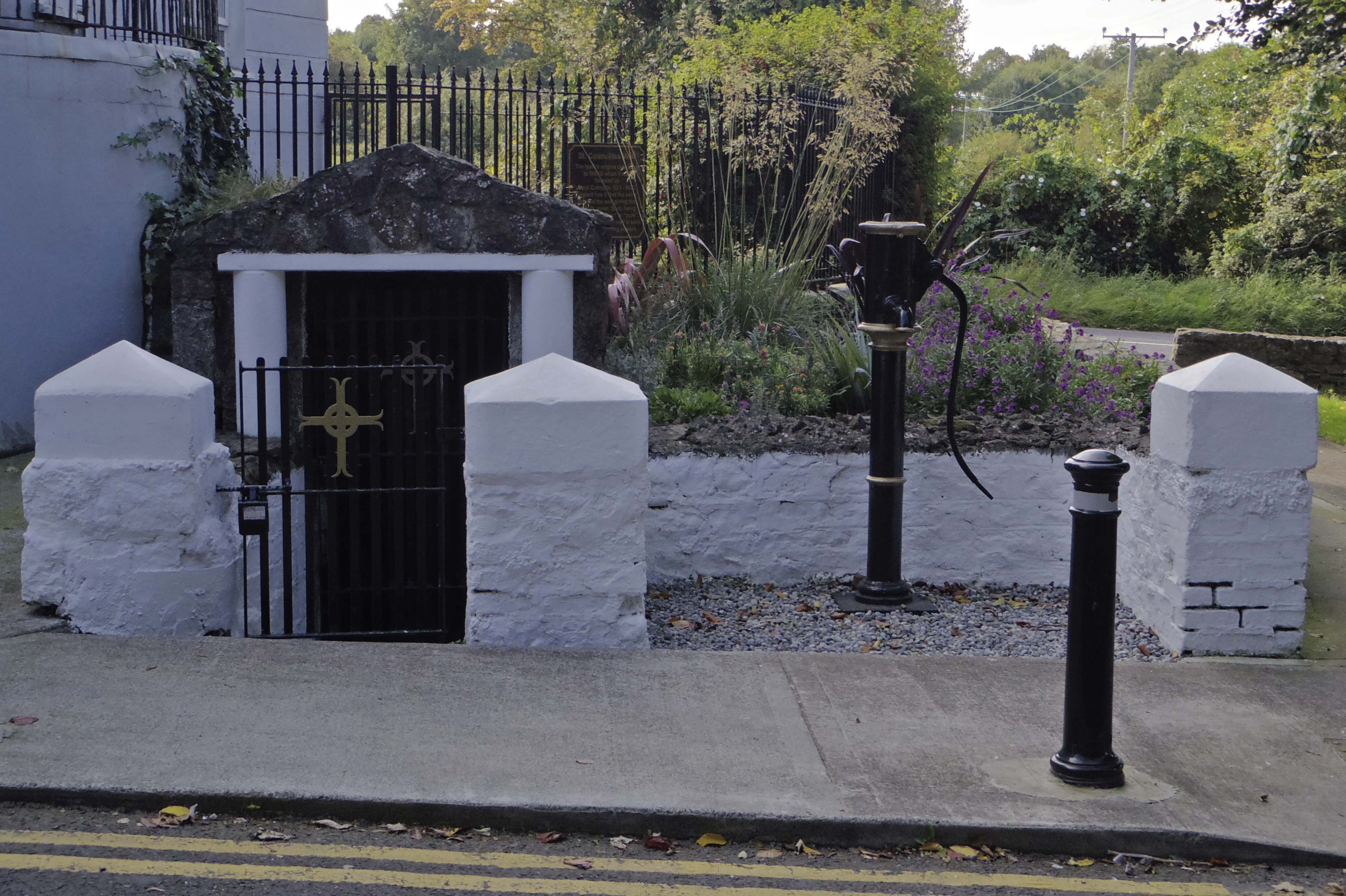
Holy well dedicated to St. Coemhín, known locally as 'Caveen', in the parish of Castleknock, located at the end of a low ridge in the SE corner of Abbotstown graveyard (DU013-020002-) which is situated on the grounds of the State Laboratory (Healy 1975, 21). The NE boundary wall consists of a modern breeze block wall. In 1757 Dr. Rutty tested the water from the well of 'St. Commegan's near Lutterell's town' (Rutty 1757, Table 1 EE). Associated with St Coemhin's Well or Caveen Well which was closed up by the landlord (Ó Danachair 1958, 74). Well site was described by Branigan (2012, 63) as; 'located outside the eastern boundary wall of the Caveen (alternatively Coemhín) graveyard on a sharp bend in a now disused road within the former Abbotstown Estate. It was capped by the landlord, Lord Holmpatrick, in the 1700s, but its site has been leaking ever since and a pool can be observed in a hollow to the south of the graveyard which is fed by a continuous trickle from this well'.
Folklore collected from Blanchardstown School recorded the following details about Caveen; 'Caveen was called after Saint Kevin. It is is now a graveyard. Long ago there was a holy well in Caveen graveyard and the people came from all parts to be cured in the well. But Lord Holm Patrick stopped the people and would not allow them to trespass on his grounds. The Lord covered the well with clay. The next morning the well had spread all around his ground.
The Lord had to get his workmen to make a shore and to let the water out. There are lots of old peoples' graves there but it is closed up now for ever. It is one of the oldest graveyards in the country. Saint Kevin used to come there to pray' (The Schools’ Collection, Volume 0791, Pages 68-9; https://www.duchas.ie/en/cbes/4498682/4385592/4498685).
Rutty, J. 1757 The Mineral Waters of Ireland. Dublin.
Branigan, G. 2012 Ancient and Holy Wells of Ireland. The History Press Ireland. Dublin.
Compiled by: Caimin O'Brien
Date of upload: 24 April 2023
The monument record does not grant public access. Check the route and ask the landowner before entering private land.