Add your own picture and explain the route, parking, gates, paths or landmarks that help people find it.
Earn 5 points after the picture is checked and accepted.
Add your photo and local directionsShare what you foundWhat is recorded here
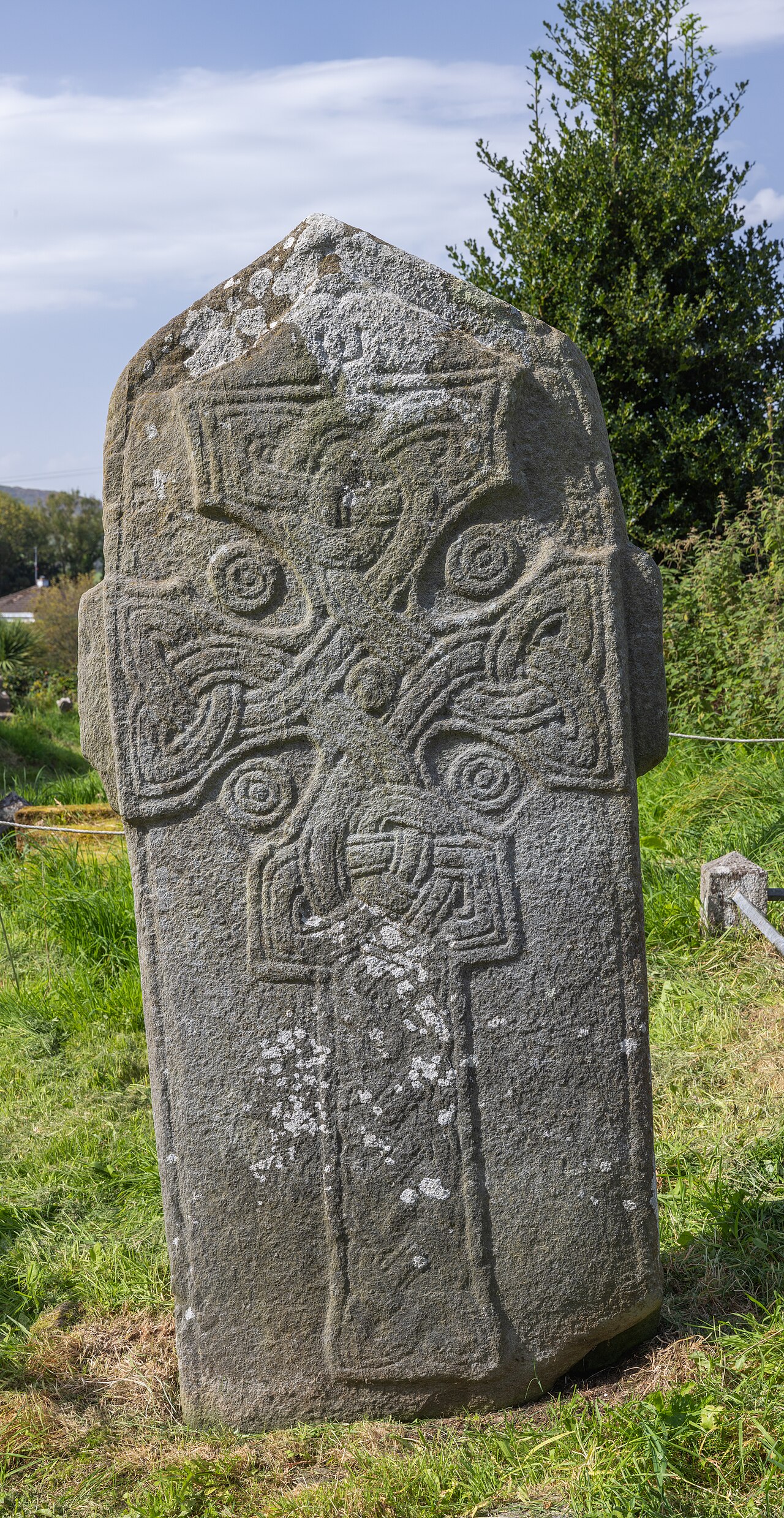
The early ecclesiastical site of Fahan consists of a modern graveyard, at a bend in the road. It is possible that this bend may reflect something of an earlier enclosure. Inside the graveyard (DG038-013004-) is part of a ruined church. Fahan old Church (DG038-013001-): In 1622, the parish church was 'well and sufficiently repaired' (Royal Commission, 191) and it continued in use until the new church was built in 1820 (Rowan 1979, 289). SE of the church is St. Mura's cross-slab (DG038-013002-). The slab is 2.1m high × 1.04m N-S and·.18m thick. The top of the slab has been worked into a triangular shape. A narrow band around the edges, frames the slab on both sides. On each side is carved a cross formed of broad double-edged interlaced ribbon. On both faces this consists of a Greek cross mounted on a stem giving the effect of a Latin cross. There is a boss at the centre of each cross. On the E face of the slab there are two small concentric circles around a small boss, in each of the hollowed angles of the cross. Two rudimentary arms protrude from the slab at a point coinciding with the arms of the cross on the E face. Also on this face, in the triangular space above the cross, are two affronted birds. On the W face of the slab a figure can be seen on either side of the cross stem. It has been suggested by Macalister, that patterns on the dress of each figure are inscriptions; however, this has been rejected by Henry (1965, 125-8). Also on the W face the cross stem expands outwards beneath the figures and acts almost as a platform. Macalister also read the doxology 'Glory and honour to the father the son' and holy spirit', inscribed in Greek characters on the N edge of the slab. This reading has been accepted by other scholars. The site of Fahan is situated in a valley at the foot of Collan Hill and Carrick Hill close to the shore of Lough Swilly. About 350m NW of the churchyard and close to the shore is a holy well (DG038-012-) dedicated to St. Mura (Ó Muirgheasa No. 89).
(Crawford 1980, 29; Gwynn and Hadcock 1970, 36; Macalister 1949, 118 20, No. 951; Spence 1910-11, 17-31) (see also DG004-005001-)
The above description was derived from the 'Archaeological Survey of County Donegal. A description of the field antiquities of the County from the Mesolithic Period to the 17th century.' Compiled by: Brian Lacey with Eamon Cody, Claire Cotter, Judy Cuppage, Noel Dunne, Vincent Hurley, Celie O'Rahilly, Paul Walsh and Seán Ó Nualláin (Lifford: Donegal County Council, 1983). In certain instances the entries have been revised and updated.
The following description of the Fahan Cross-decorated slab is taken from, P. Harbison (2002-) The High Crosses of Ireland: An Iconographical and Photographic Survey, 3 vols., Habelt, Bonn, vol. 1. 88-9).
Cross-decorated slab
'Standing close to the roofless church in the churchyard of Fahan Mura is an upright slab with triangular top, which is included in this corpus not because of the arm-like tenons projecting from its sides, but also because of the role it has played in the discussions about the evolution of the 'Celtic' cross. The slab is 2.10m tall, 90cm wide and 20cm thick at the bottom. The corners have a roll moulding, and the tenons project from the narrow sides to a maximum of 7cm. The south side is undecorated.
EAST FACE
A cross outlined by a raised moulding stands out in relief from the east face. It is filled with interlacing which has a broad central band flanked on each side by a narrower band. There is a boss in the centre of the cross, and in each armpit there is another having two concentric circles on its upper surface. There are two birds facing one another in the gable at the top of the slab, their curving beaks crossing one another.
WEST FACE
The west face has a cross standiing out in some relief, but its interlace and terminals have a more elaborate form than those on the cross on the east face. There is a rounded boss at the centre of the cross, surrounded by three-strand interlace with broad central band, which stands in relief on the cross surface and which crreates an arcaded shape at the end of the terminals. The interlace of the shaft of the cross on this face is more closely meshed. There is a single figure standing in profile on wither side of the shaft, which some have identified as ecclesiastics, and others as women. Their hair falls down in strands behined the steep fronted heads, and on their long garments there are inscriptions which have never been satisfactorily deciphered. The interlace of the shaft of the cross branches out on either side at the bottom to form a platform for the two standing figures.
NORTH SIDE
On the north side there is a two-line Greek inscription running from top to bottom which Macalister deciphered as follows :
Glory and Honour to the Father and to the Son and to the Holy Ghost'
Attached photos, taken on 15th December 2006:
DG038-013002-_01.JPG East face
DG038-013002-_02.JPG North side
DG038-013002-_03.JPG West face
Date of upload: 22 September 2008
The monument record does not grant public access. Check the route and ask the landowner before entering private land.