Add your own picture and explain the route, parking, gates, paths or landmarks that help people find it.
Earn 5 points after the picture is checked and accepted.
Add your photo and local directionsShare what you foundWhat is recorded here
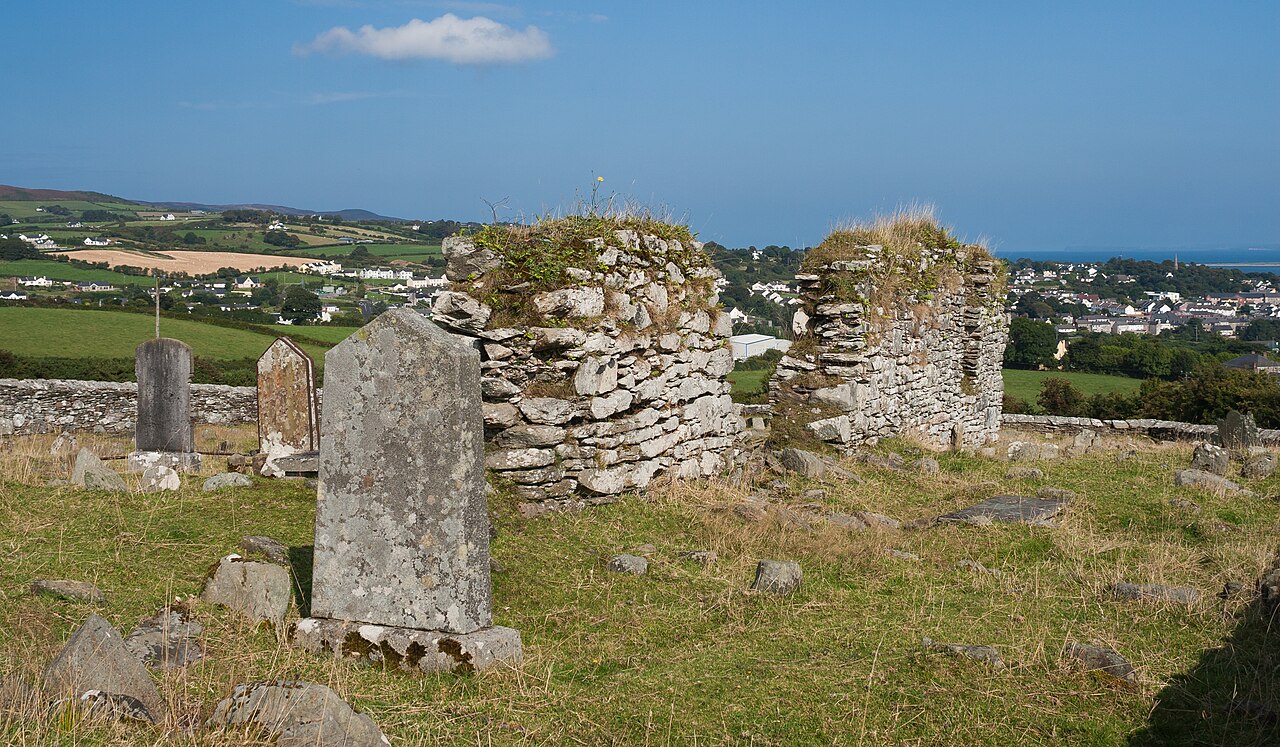
The early ecclesiastical site here consists of a sub-rectangular shaped graveyard inside of which are a number of earlier features. The site is located on excellent land sloping to Lough Foyle to the E and is traditionally claimed to have been founded by St. Patrick (Gwynn and Hadcock 1970, 399; Lacy et. al. 1983, 261). To the W outside the entrance to the graveyard (DG021-008001-) is a tall, plain, ringed high-cross (DG021-008005-). Inside the graveyard are the remains of two churches (DG021-008002-/003-) and a mortuary house or tomb shrine (DG021-008004-). One of the churches served as a medieval parish church (Leslie 1937, 265). South Church (DG021-008002-): only the S wall of this survives. It is built of rubble, is c. 19m long and 2.8m high. There are openings for two windows now reduced to featureless gaps, although the more easterly preserves a fragment of a splayed ingoing, There is a wall-press with ruined jambs at the E end of this wall. The E limit of the church is marked by regularly spaced bond holes in the interior wall face. The lower courses of the interior face of the W wall survive but the SW corner is obscured by fallen masonry.
The first church at Cooly appears to have been known as 'Domnach Bili' [church of the ancient/sacred tree] which was according to local tradition associated with St Patrick in the 5th-century (Gwynn and Hadcock 1970, 399). According to this tradition St Patrick went from Domnach Mor Maige Tochair (Donagh) into the Bretach and ordained Oengus son of Ailill at Domnach Bili (Gwynn and Hadcock 1970, 399). In medieval times the eastern half of the barony of Inishowen was known as Breadach [Bretach] (AFM vol. 2, 1162). The church at Cooly was also known as Magh Bile (plain of the ancient tree / Moville). A second monastery can be found at Moville in Co. Down which is associated with St Finnen and it is not clear in some of the annalistic references which Moville is referred to. In 953 AD the annals record the death of 'Aenghus, son of Loingseach, airchinneach [erenagh] of Magh-bile' (AFM vol. 1, 671). In 1167 the annals recorded that 'Muircheartach, son of Ladhmaun Ua Duibhdhiorma, lord of Fordruim [Fordrum], pillar of the magnificence of all the north of Ireland, was treacherously slain by Donnchadh Ua Duibhdhirma, and by all the people of Bredach, in the middle of Magh-bile (Moville/Cooly)' (AFM vol. 2, 1163). The present town of Moville is located 1.2km to the E of Cooly.
The church of 'Macgurbili' [Magh-bili/Moville/Cooly] is valued at 40s. in the 1302-06 ecclesiastical taxation of the Diocese of Derry (Cal. doc. Ire., 215). In 1412 AD Robert Makellis was appointed to the rectory of 'Magerbili [Cooly] alias Norraborg in the said diocese, so long void by the death of Donald Macglalacind' (Cal. papal letters, 255). In 1419 AD it is recorded that 'David Omaelmuchoirdhi, clerk, of the diocese of Derry (who lately had papal dispensation, as the son of a priest and a married woman, to be promoted to all, even holy orders and hold a benefice even with cure), the perpetual vicarage of Magbili [Cooly] in the said diocese, value not exceeding 10 marks, of the patronage of laymen, so long void by the death of Denis Ogormali' (Cal. papal letters, 104). In 1427 AD there is a reference to John Ogubuin, rector of Cluainmane (Clonmany] in the diocese of Derry who also holds the 'rectory or plebania of Maghbhile in the said diocese' which was valued at 20 marks (Cal. papal letters, 547). In this year there is a dispute between John Ogubuin, rector of Clonmany and 'Robert Mackeallaidh, rector or plebanus of Maghb[h]ile, [who is accused] of being a perjuror and notorious fornicator, and of dilapidating the fruits etc. of Maghbhile for the benefit of his concubine and others, and if he find the charges to be true, to deprive and remove Robert, and in that event to collate and assign 20 marks to John; notwithstanding that he holds the said rectory of Cluainmaine' (Cal. papal letters, 548). In the same year John Ogubyn was granted 'the canonry of Derry and another of Raphoe, with reservation of a prebend of each; notwithstanding that he holds the rectory of Cluoinmane [Clonmany], and that the pope lately ordered provision to be made to him of the rectories or plebanie of Maghbhile [Cooly] and Cluainchata [Clonca], value not exceeding 8. 20 and 14 marks respectively' (Cal. papal letters, 104). In 1430 AD the church was once more at the centre of a dispute when David Omaelmuchoregi, a priest who obtained the vicarage of Magbili [Cooly] after the death of the former vicar Denis Ogormali petitioned against Henry Maccolgan who had falsely suggested 'to the pope that it had become and was void by the death of Magonius sive Magnellus Omaelrathi, and that David had unduly detained it for more than four years' (Cal. papal letters, 179).
The above description was derived from the 'Archaeological Survey of County Donegal. A description of the field antiquities of the County from the Mesolithic Period to the 17th century.' Compiled by: Brian Lacey with Eamon Cody, Claire Cotter, Judy Cuppage, Noel Dunne, Vincent Hurley, Celie O'Rahilly, Paul Walsh and Seán Ó Nualláin (Lifford: Donegal County Council, 1983). In certain instances the entries have been revised and updated.
Compiled by: Caimin O'Brien
Date of revised upload: 24 February 2015
The monument record does not grant public access. Check the route and ask the landowner before entering private land.