Add your own picture and explain the route, parking, gates, paths or landmarks that help people find it.
Earn 5 points after the picture is checked and accepted.
Add your photo and local directionsShare what you foundWhat is recorded here
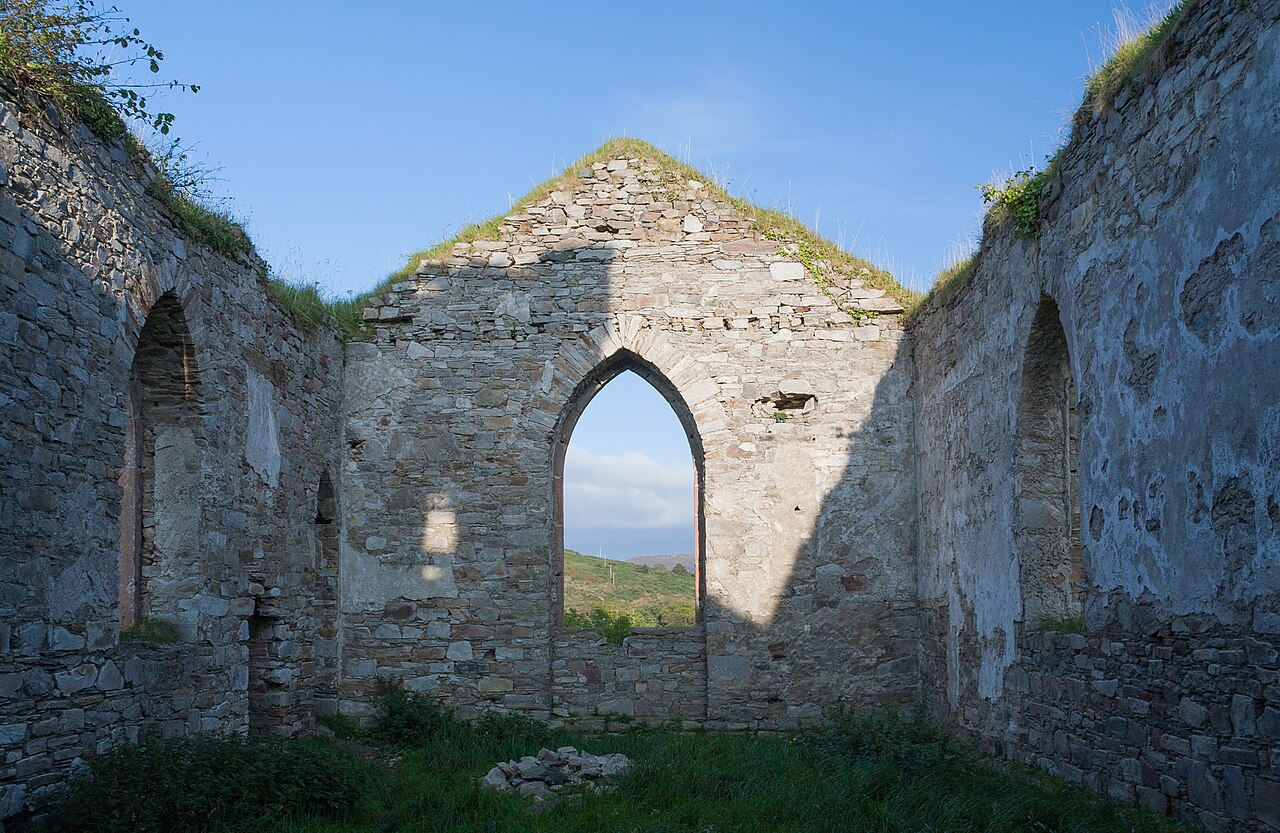
This is believed to be the early ecclesiastical site of Culmaine (Gwynn and Hadcock 1970, 377). The site presently consists of a graveyard (DG010-011001-) surrounding a ruined 18th century church 14m from the SE corner of the church is a flat-surfaced stone, .3m x .52m, on which are two small cupmarks. Traditionally these are known as St. Colmcille's knee-prints (DG010-011002-). It is situated in a band of good land in generally rough pasture sloping NE to the Clonmany river. Beside the church there stood in 1600 a castle (DG010-011004-) (probably a stone house) which was inhabited by a priest called Amerson (Davies and Swan 1939, 198). No visible trace of this structure survives and its exact location is unknown. A souterrain (DG010-046----) was recently discovered in the front garden of a bungalow immediately W of the C of I church.
The above description was derived from the 'Archaeological Survey of County Donegal. A description of the field antiquities of the County from the Mesolithic Period to the 17th century.' Compiled by: Brian Lacey with Eamon Cody, Claire Cotter, Judy Cuppage, Noel Dunne, Vincent Hurley, Celie O'Rahilly, Paul Walsh and Seán Ó Nualláin (Lifford: Donegal County Council, 1983). In certain instances the entries have been revised and updated.
Date of upload: 22 September 2008
The official description records surviving remains. Its missing or destroyed wording refers only to one part of this place or to a different nearby feature.
The monument record does not grant public access. Check the route and ask the landowner before entering private land.