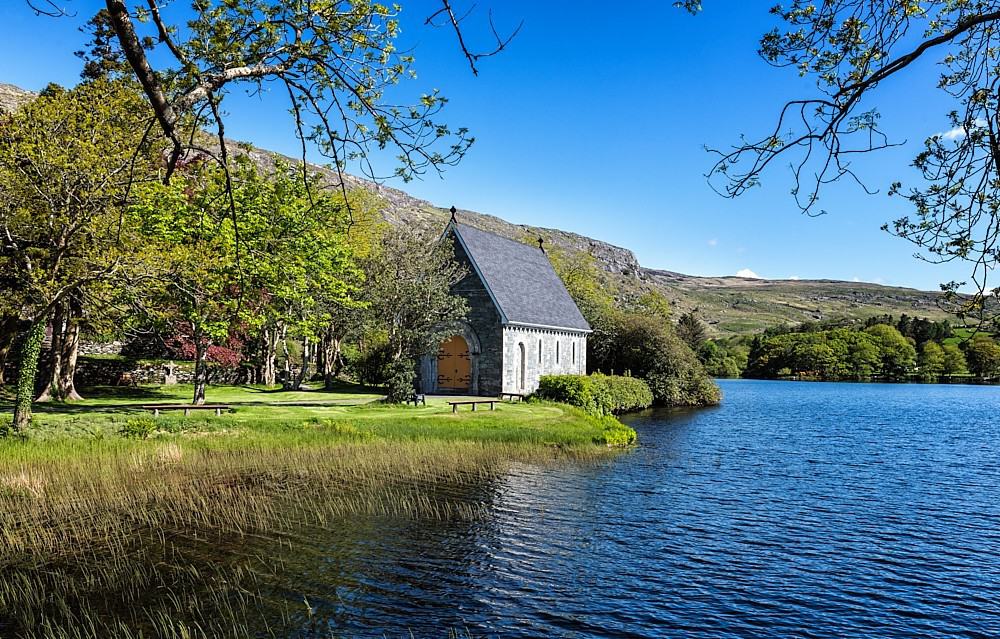
Add your own picture and explain the route, parking, gates, paths or landmarks that help people find it.
Earn 5 points after the picture is checked and accepted.
Add your photo and local directionsShare what you foundWhat is recorded here
In the centre of a field of marshy pasture on a gentle S-facing slope with views obscured by hedgerows. Accessed from the Ennistymon-Kilfenora road via a stile. Indicated and named ‘Tobercravan’ on the 1840 and 1916 OS 6-inch maps. O’Donovan (1839) noted the well ‘called Tobar-na-Crabhain or Mac Craven’s Well at which Stations are still continued to be performed and cures expected’ (Comber 1997, 99). Westropp (1910, 150) noted the well ‘called Tober Mac Crabhain, at which stations were held in the latter year, but its patron was uncertain’. According to Barry (1976, 81) the patron was St Craven, ‘a contemporary of St Caimin of Ballykinvarga’. He reported that the rounds were performed on Thursday-Monday-Thursday or Monday-Thursday-Monday. ‘Five Paters, Aves and Glorias are said kneeling before the well, and then five decades of the Rosary are recited while walking slowly five times around the well in a clockwise direction. The round is then concluded by blessing the eye or eyes, with the water, by taking three sips in the name of (1) the Father, (2) the Son, and (3) the Holy Ghost, and finally by crossing oneself with water from the well’ (ibid.). Barry noted that the stone wall was built around the well c. 1976 by the owner (ibid., 80). Lenihan (1997, 54) found little knowledge about the well in the locality.
A holy well within a wellhouse surrounded by a penannular enclosure (diam. 7.9m) defined by a drystone wall (H 1m). The wellhouse is D-shaped (1.4m N-S; 1.6m E-W) and faces E. A curved drystone wall lines the sides of the well terminating in a pair of mortared entrance pillars. The structure is roofed with a large limestone slab surmounted by a small box with concrete sides and a flag roof which houses a collection of religious statues. A large holly tree and a cluster of whitethorn bushes are growing to the rear of the wellhouse.
References:
Barry, P. 1976 St. Craven’s well, near Ennistymon, Co, Clare. North Munster Antiquarian Journal 18, 80-81.
Lenihan, E. 1997 The holy wells of Kilshanny Parish. The Other Clare 21, 52-7.
Westropp, T. J. 1910 Notes on the antiquities around Kilfenora and Lehinch, Co. Clare, part III. North Munster Archaeological Society 1, 147-59.
The following images have been uploaded:
CL015-074----_01.jpg View of well enclosure from SE
CL015-074----_02.jpg Well with statues housed above
Compiled by: Mary Tunney and Eve Campbell
Date of upload: 15 August 2023
The monument record does not grant public access. Check the route and ask the landowner before entering private land.