Add your own picture and explain the route, parking, gates, paths or landmarks that help people find it.
Earn 5 points after the picture is checked and accepted.
Add your photo and local directionsShare what you foundWhat is recorded here
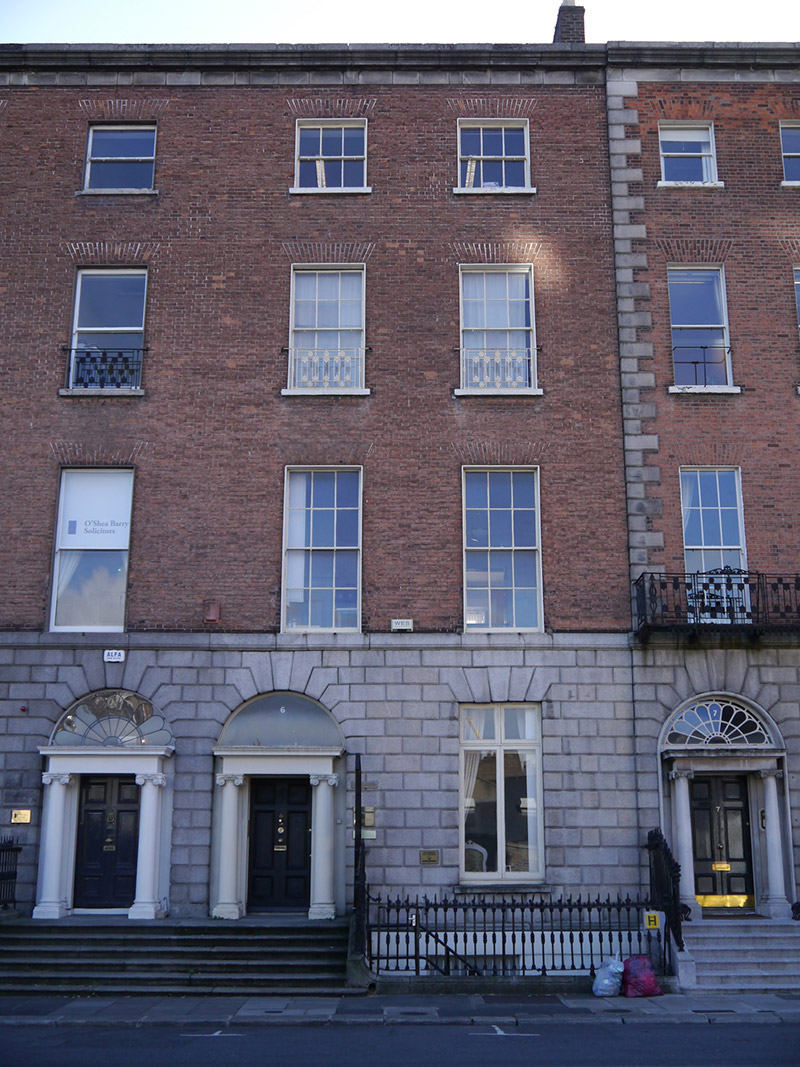
Terraced two-bay four-storey over basement former townhouse, built c. 1825, as a group comprising Nos. 5-7 (50930133-5). Two-storey return to rear. Now in use as offices. M-profiled slate roof, hipped to north, concealed by ashlar granite parapet with moulded cornice and coping, pair of brick shouldered chimneystacks to south party wall with yellow clay pots. Parapet gutters. Red-brick walling laid in Flemish bond, rusticated ashlar granite walling to ground floor over coursed ashlar limestone walling to basement beneath granite stringcourse. Square-headed window openings with brick voussoirs, patent reveals and projecting granite sills. Cast-iron balconettes to second floor openings and metal grille affixed to basement opening. Generally six-over-six original sliding timber sash windows with cavetto horns, three-over-three to third floor, one-over-one replacement to basement and bipartite replacement timber casement to ground floor with top-hung overlights. Round-headed door opening to principal elevation (west) with rendered engaged Scamozzian-Ionic pilasters and surrounds, framed by distyle prostyle portico over matching columns, having plain frieze and moulded cornice rising to replacement plain glass fanlight over six-panelled timber door with beaded-muntin and brass furniture. Shared granite entrance platform approached by six bull-nosed granite steps flanked by cast-iron railings with arrow-head finials, enclosing basement to south-side. Coal-hole cover to pavement. Modernised two-storey mews building to rear (east) with integral square-headed carriage-arch, concealed behind random roughly dressed limestone boundary wall to Lad Lane with shared square-headed vehicular opening and separate pedestrian opening, each having replacement steel gates.
This official record and map point do not grant access. Most recorded buildings are privately owned; view them only from public ground unless the owner allows entry.