Add your own picture and explain the route, parking, gates, paths or landmarks that help people find it.
Earn 5 points after the picture is checked and accepted.
Add your photo and local directionsShare what you foundWhat is recorded here
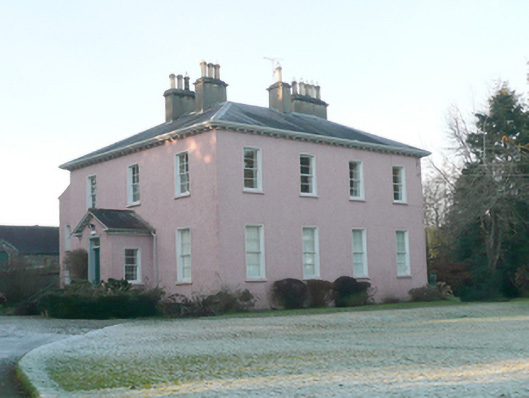
Detached three-bay two-storey over basement house, built c. 1845, having central single-bay gable-fronted entrance porch to the main elevation (south), two-storey over basement return to the rear (north) at the north-east corner, two-storey over basement extension to west with mono-pitched roof over, and with single-storey over basement extension to north-west. Hipped natural slate roof with overhanging bracketed eaves, surviving sections of cast-iron rainwater goods, and a central pair of rendered chimneystacks to front block having terracotta pots over, and two smooth rendered chimneystacks to returns having terracotta pots over. Pitched natural slate roof to porch with overhanging bracketed eaves forming open bed pediment to front (south). Mono-pitch slate roof to west extension. Roughcast rendered walls. Square-headed window openings with smooth rendered reveals, stone sills, and four-over-four pane timber sliding sash windows. Paired square-headed window openings to the front elevation at basement level having timber sliding sash windows with margin glazing bars. Square-headed doorway to the front face of porch (south) having timber panelled door with fielded panels, smooth rendered reveal, overlight, and with decorative timber lintel over with diamond motifs. Doorway approached by series of stone steps having flanking dwarf walls to either side and metal railing to west. Set well back from road in extensive mature landscaped grounds with mature trees to the west of the centre of Lifford. Gateway to the east having a pair of smooth rendered gate piers (on square-plan). Squared and snecked boundary wall to south having large field stone coping over to west. Complex of outbuildings to the rear (west).
This official record and map point do not grant access. Most recorded buildings are privately owned; view them only from public ground unless the owner allows entry.