Add your own picture and explain the route, parking, gates, paths or landmarks that help people find it.
Earn 5 points after the picture is checked and accepted.
Add your photo and local directionsShare what you foundWhat is recorded here
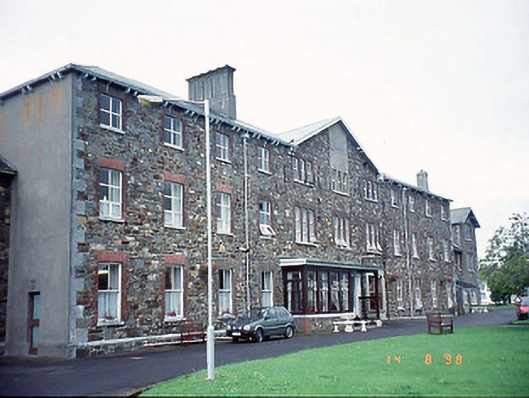
Detached irregular-plan twenty-seven-bay two- and three-storey rubble stone-built Victorian hospital, built c. 1850, possibly originally Union Workhouse. Originally U-shaped about a courtyard comprising eleven-bay three-storey central block with three-bay three-storey gabled bay to centre, six-bay two-storey recessed flanking lateral wings, two-bay three-storey double-gable fronted projecting flanking blocks, and fourteen-bay three-storey side elevations to north-east and to south-west having two-bay four-storey gabled breakfront to north-east and three-bay three-storey triple-gable-fronted projecting bay to centre of south-west elevation and six-bay single-storey return to rear to north-west (now in enclosed courtyard). Renovated and extended, c. 1940, with three-bay three-storey infill range added to north-west closing quadrangle with two-bay two-storey flat-roofed return to west. Renovated in late twentieth century and with two-bay single-storey flat-roofed projecting glazed porch added to entrance bay. Pitched and hipped roofs with rendered chimneystacks. Coursed random rubble stone walls having grey limestone plinth band and quoins. Red brick flat arches and reveals to openings, many arches replaced on façade. Retaining some timber two-over-two pane sliding sash windows and having replacement windows. Detached two-bay single-storey double-gable-fronted rubble stone-built building, built c. 1850, retaining some original fenestration with four-bay side elevations, extended to north in late twentieth century. Detached three-bay single-storey triple-gable-fronted rubble stone-built building, built c. 1850, with four-bay side elevations. Twin triple-gabled lodges facing each other across entrance drive.
This official record and map point do not grant access. Most recorded buildings are privately owned; view them only from public ground unless the owner allows entry.