Add your own picture and explain the route, parking, gates, paths or landmarks that help people find it.
Earn 5 points after the picture is checked and accepted.
Add your photo and local directionsShare what you foundWhat is recorded here
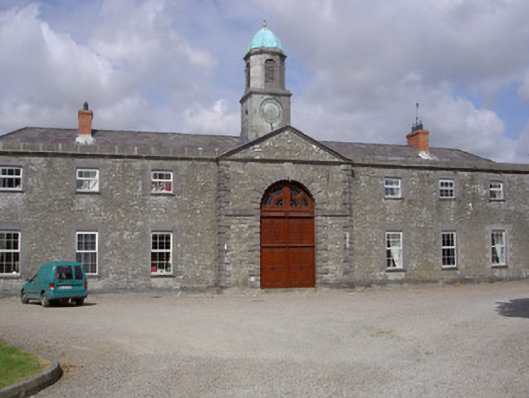
Stableyard, built c. 1790. Consisting of three interlinked courtyards, walled garden attached to south-west; principal courtyard to east, seven-bay two-storey east elevation, central pedimented breakfront containing round-headed double-height carriage arch, crowned by lantern and copper cupola, converted to residential use; internal yard consisting of four two-storey ranges; west courtyards divided in two by central block with brick bell tower; single-storey rubble masonry buildings form south-west and north range while two-storey rear elevation of principal courtyard forms east range; external staircase on three brick-built supporting arches gives access to upper storey on this range; forge to south-east corner. Pitched and hipped slate and corrugated-iron roofs, cast-iron rainwater goods; ashlar limestone lantern to main range, square-profile base, octagonal bell tower, copper domical vaulted cupola. Random rubble stone walling, tooled ashlar limestone plinth to principle courtyard, tooled limestone quoins to east elevation; brick columns to south and west range of west courtyard. Square-headed window openings, ashlar limestone block-and-start surrounds, limestone sills, uPVC casements,. Square- and segmental-headed door openings, ashlar limestone block-and-start surrounds, painted timber vertically-sheeted doors; double-height round-headed opening to east, ashlar limestone block-and-start surround, timber double doors and fanlight,; ashlar limestone horseshoe door opening to forge, round-headed carriage opening to north-west. Walled garden to south-west, red brick laid in Flemish bond to north, east and west walling and rubble masonry to south. Cobblestones to yard, stables set back from road in to north-west of Rokeby House.
This official record and map point do not grant access. Most recorded buildings are privately owned; view them only from public ground unless the owner allows entry.