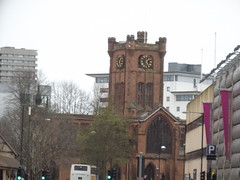
What is recorded here
This blue commemorative plaque records: The Collegiate and Parish Church of St. John the Baptist This church was founded in 1344 by Queen Isabella widow of King Edward II, on land called 'Babblake' and was granted by her to the Guild of St. John the Baptist. It was to be served by two chaplains from the 'College of Bablake'. Those priests were to say a daily mass for, the repose of the soul of her late husband King Edward II, her son King Edward III, her daughter in law Queen Phiippa, her grandson Edward the Black Prince and members of the Guild of St. John. The building was consecrated on 2nd May 1350 to God and St. John the Baptist. By the time of the dissolution of the Guilds in 1548, the church was closed and given to the Mayor of the Corporation. During the time of the Commonwealth (1642-1660), the church was used as a prison for Royalist soldiers captured at the Battle of Preston. As the sympathies of the citizens of Coventry lay with the Parliamentarians, they gave the Royalist prisoners a hostile reception giving rise to the saying 'sent to Coventry', meaning that someone is ignored or treated coldly. After many years lying empty, occasionally being used to hold markets and as a stretch yard for dyed cloth, the Corporation agreed to reopen the church as a place of worship. It was created a Parish Church on 24th July 1734. Today the church serves the spiritual and other needs of this community and the city. Recorded plaque organisation: Diocese of Coventry.
King Edward II of England (1284-1327) reigned from 1307 until his deposition in 1327, marked by conflicts with barons and his eventual forced abdication; Queen Isabella of France (c.1295-1358), known as the She-Wolf of France, played a significant role in deposing her husband Edward II and acted as regent for their son, Edward III, before being marginalized by him later in life.
A plaque record does not grant entry to a building or private land. View it from a public place unless permission is clearly given.
Places near here
 Church of St John the BaptistListed building · 12 yd
 Spon GateArchaeological place · 36 yd
 188-190 Spon StreetListed building · 47 yd
 Coventry Watch MuseumMuseum · 158 yd
 Sculpture entitled 'Two Sides of a Woman' outside the Belgrade Theatre, CoventryPublic sculpture · 186 yd
 Rail Trail: Coventry's Historic CentreWalking route · 262 yd
 Sir Thomas WhiteMemorial · 487 yd
 Coventry : Milestone HouseMonument or public art · 489 yd
_was_educated_(geograph_6844690).jpg?width=1280) George Eliot PlaqueMemorial · 532 yd
George Eliot PlaqueMemorial · 532 yd Visitor InformationVisitor information · 857 yd
 Bablake SchoolListed building · 57 yd
 Bonds HospitalListed building · 78 yd
Other information
Photo: Elliott Brown · CC BY-SA 2.0