What is recorded here
A broken corner marks the limestone panel now set at the Callan South church porch, but its carved Trinity still projects from the stone with startling life. God the Father sits on a bench-like throne, holding the crucified Christ across his knees while a dove hovers between his beard and the cross. The panel survived its move from medieval St Mary’s, carrying with it the risk that Rory O’Tunny chiselled more than doctrine: he may have shaped the dread and tenderness of death into something a worshipper could touch.
At the N end of the entrance porch to the RC church in Callan. In the early part of the 19th century the carved panel was moved to the present RC church from the medieval church of St Mary's (KK026-010012-) which is located c. 190m to the NE, on the E side of the N end of Green St. (Roe 1979, 130).
The limestone panel (H 0.6m; Wth 0.54m; T 0.1-0.11m) is carved with the Holy Trinity in high relief (projecting 0.14-16m from the surface of the panel), depicted a seated God the father, with the crucified Christ resting on his knees and between the long flowing garment covering his legs, and the Holy Spirit, in the form of a dove facing upwards with slightly open wings, between God's beard and the arms of the cross. The dexter corner of the panel, to just below half way down, has been broken off.
God the father is sitting on a bench-like throne and on his head he is wearing what Roe (1979, 130) describes as, 'a low diadem with six fleurons', which, when viewed from above, 'is shown as a multi-petalled rosette which might indicate the wearing of some sort of fabric cap (?). His hair in two great swags hangs to his shoulders and his neat beard is arranged in three close coils. Except for the eyes, the pupil and iris clearly marked on the somewhat protuberant eyeball. Over a voluminous pleated alb he wears an equally voluminous mantle with the tight fitting fur-bordered (?) tippet or shoulder cape: the lower folds of the mantle are draped back over his knees. The Father blesses with his right hand, which is partly broken away with the damaged upper part of the slab, and supports the end of the transom of the cross with his left'.
Roe (ibid.), describes Christ with, 'arms straining from the nailed hands; the body stretched from its weight and the legs contracted at the knees with feet crossed and pierced by a single nail'.
Roe attributes the carving to Rory O’Tunny and suggests that it came from a chantry in the medieval church dedicated to the, Holy and Undivided Trinity of St Catherine’ (ibid. 130-31).
See attached photograph:
KK026-010032-_01 Urban Archaeological Survey (October 1992)
Compiled by: Jean Farrelly
Date of upload: 29 June 2022
Probably dating to the early medieval period, the stone sculpture may have originally served a liturgical or commemorative function before being relocated. Its carving style may reflect Christian symbolism or earlier traditions incorporated into ecclesiastical settings.
The monument record does not grant public access. Check the route and ask the landowner before entering private land.
- What survives
- Recorded monument
Places near here
 Church in Callan SouthChurch · 13 yd
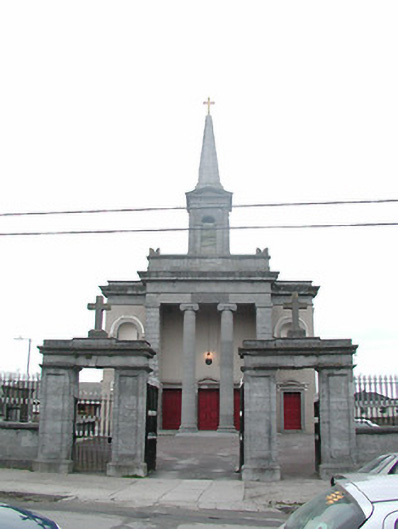 Catholic Church of the Assumptiongates/railings/walls · 23 yd
 Edmund Rice MemorialMemorial · 43 yd
 Green StreetVisitor information · 50 yd
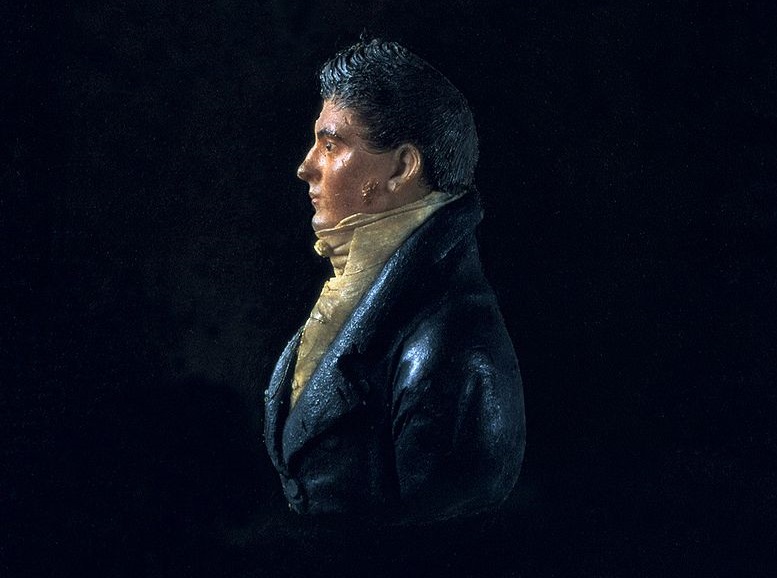 James Hoban MonumentMemorial · 87 yd
 Stop 4: Callan Town HallVisitor information · 157 yd
 CrossCross, Market cross · 261 yd
 CastleCastle, tower house · 272 yd
 St. Augustines WellHoly well · 439 yd
 West CourtCastle, unclassified · 864 yd
 Edmund Rice Heritage CentreMuseum · 1262 yd
 Mill IslandIslet · 1.1 mi