What is recorded here
Half a kilometre east of Ballyferriter, tiny stone boxes no larger than a child’s embrace sit beneath quartz and sea pebbles, while larger graves hold the forgotten adults. The smallest chambers contain nothing but pebbles and one delicate carv
National Monument No. 519. Calluragh burial ground/An Cheallnúach: KE042-060001- is located about 1.25km E of the village of Ballyferriter on approximately the highest point in the townland with a good view to the N over Smerwick Harbour.
(7) Ceallúnach: This area lay to the E of the roadway. Excavation revealed a rectilinear enclosure built against the inner face of the E section of the enclosure wall and incorporating the remains of the stone oratory. On the N and W the wall consists of an inner face of erect slabs backed externally by courses of dry-walling. Overall internal dimensions are 10 x 6.4m and the wall is .8m wide. Within this enclosure, and also to the S of the oratory, the excavations revealed a number of roughly built ceallúnach graves, averaging 2 x 2m, constructed of erect and flat stones and covered with spreads of quartz and sea pebbles. Internally these stone boxes were sub-divided by other erect slabs. Associated with these large graves were a number of very small graves consisting of 3 or 4 stones set on end and covered by a single larger stone to form a small stone box .5 x .3m. Only a few traces of skeletal remains had survived but some of the graves yielded small collections of pebbles similar to jackstones and one yielded a tiny stone figurine.
The above description is derived from J. Cuppage, ‘Corca Dhuibhne. Dingle Peninsula archaeological survey. Ballyferriter. Oidhreacht Chorca Dhuibhne’ (1986), no. 874. In certain instances the entries have been revised and updated in the light of recent research.
Date of upload: 9 August 2013
A Neolithic passage tomb; dates to the 4th–3rd millennium BCE. It is part of a significant funerary landscape in west Kerry and represents early communal burial practices in the region.
The monument record does not grant public access. Check the route and ask the landowner before entering private land.
- What survives
- Recorded monument
Places near here
 Shrine in An RiascShrine · 3 yd
 Riasc Monastic SettlementHeritage attraction · 29 yd
 Hut site in An RiascHut site · 144 yd
 Church (in ruins)Church · 1004 yd
 Séipéal Uinseann Naofa [Saint Vincent's Catholic Church]church/chapel · 1353 yd
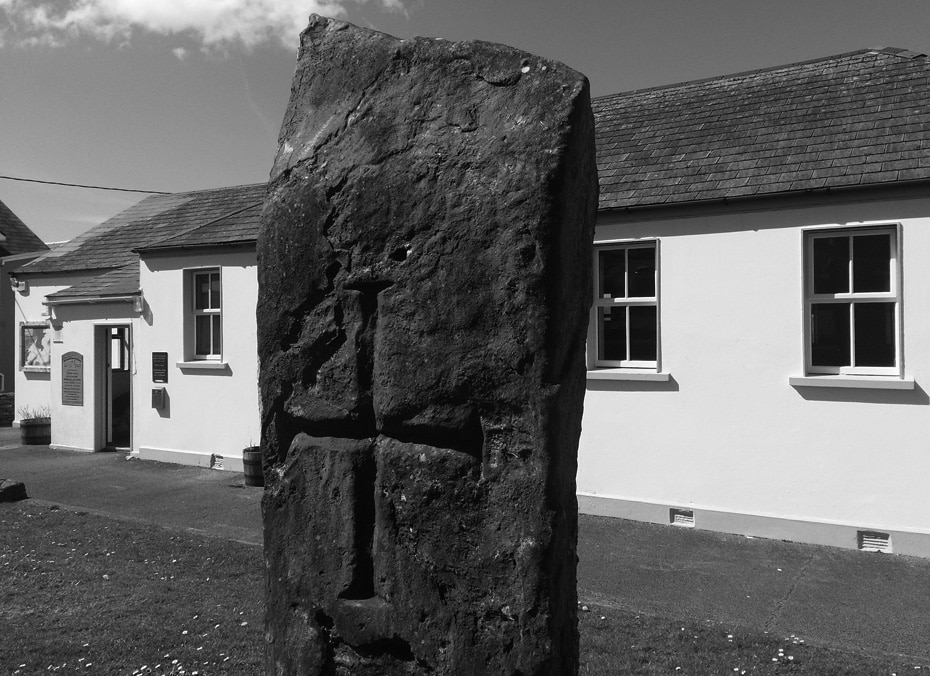 Músaem Chorca DhuibhneMuseum · 1397 yd
 Ballineanig HillMountain / peak · 1397 yd
 Trá an FhíonaBeach / strand · 1412 yd
 St Brendan's WellSpring · 1.1 mi
 Tráigh Bhéal BánBeach / strand · 1.4 mi
 Gallarus Castle (in ruins)Castle, tower house · 1.5 mi
 Gallarus CastleCastle · 1.5 mi