Overview
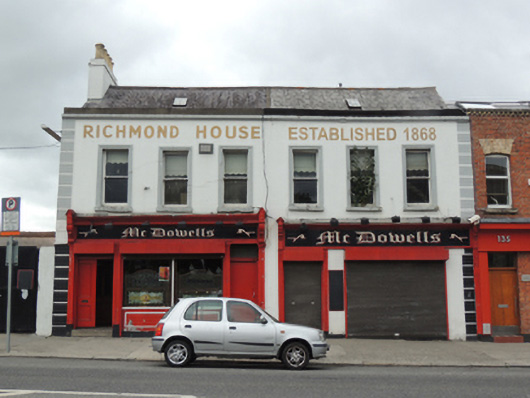
McDowells — Emmet Road is recorded as public house in Dublin. Attached pair of three-bay two-storey former houses with attic accommodation, dated 1868, now in use as public house and having shopfronts to front (south) elevation, with lower two-storey lean-to return to rear (north) elevation. Pitched slate and artificial slate roof having rooflights, lined-and-ruled rendered chimneystack to west gable, rendered parapet with cornice to front (south) elevation, and cast-iron rainwater goods.
Why it was built
The saved account records: Attached pair of three-bay two-storey former houses with attic accommodation, dated 1868, now in use as public house and having shopfronts to front (south) elevation, with lower two-storey lean-to return to rear (north) elevation.
People and work
The saved account records: Pitched slate and artificial slate roof having rooflights, lined-and-ruled rendered chimneystack to west gable, rendered parapet with cornice to front (south) elevation, and cast-iron rainwater goods.
How it changed
The saved account records: Lined-and-ruled rendered walls, having channelled quoins, and painted lettering.
What survives
The saved account records: Square-headed window openings, having rendered window surrounds, painted sills, and one-over-one pane timber sash windows.
Why it mattered
McDowells — Emmet Road matters for the exact reasons given in its official assessment, rather than merely because it is an old structure. The source records: This public house occupies a corner site on Emmet Road and shares similar scale and proportions with neighbouring buildings, making a positive contribution to a coherent streetscape. Its form is enhanced by render detailing such as its window surrounds and quoins, while timber sash windows add a patina of age. The survival of the shopfronts is significant, demonstrating the quality of craftsmanship in the nineteenth and early twentieth centuries. Richmond House was a popular public house with the soldiers of Richmond Barracks, an infantry barracks built to the immediate south in 1810 and closed in 1924. The… This explains what the place adds to local life, the street or the surviving built history.
History checked 15 August 2026 against the named sources below.
Add the human story, a picture, a first-hand message or a missing place.
Earn 5 points after the picture is checked and accepted.
Add a pictureAdd its storyTalk or ask a questionAdd a new placeThis official record and map point do not grant access. Most recorded buildings are privately owned; view them only from public ground unless the owner allows entry.
Conversation about this place
Questions and messages sit beneath the source record. They are checked before appearing.
No questions or messages yet.
Ask a question or join the conversation