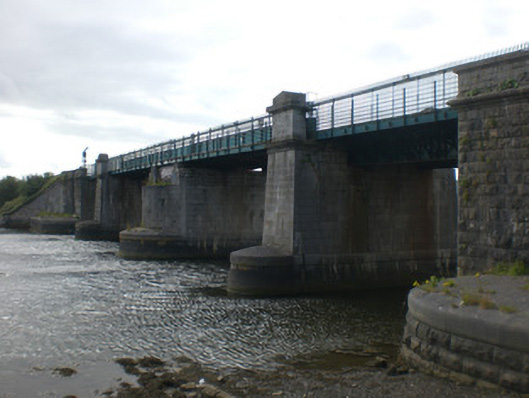
What is recorded here
Freestanding five-span viaduct, dated 1851, spanning arm of Lough Atalia, having four spans over water and one arch over Lough Atalia Road. Comprises three ashlar limestone piers to river, having battered sides, U-cutwaters to each elevation, string course continued to form caps to cutwaters, moulded cornices, parapet having cut-stone cornices and gabled caps. Parapet and some lower stonework missing from both elevations of middle pier. Landward piers comprise coursed rock-faced stonework with moulded string course and cut-stone coping to parapet, and having splayed abutments of similar construction and detailing. Wrought-iron box-girder construction to river spans and segmental wrought-iron arch structure to road, supported by wrought-iron trusses and having cast-iron elevations with maker's plaques, and cast-iron parapet. Earthen embankments beyond each end of bridge. Railway station adjacent to north-west.
This impressive railway viaduct has well executed limestone piers and wrought- and cast-ironwork bridge is an excellent example of the engineering work of the mid-nineteenth century. It is particularly noteworthy that James Stephens of Galway was responsible for the ironwork of the structure, they having a foundry close by between Dock Road and Merchant's Road. The attention to detail evident throughout the viaduct is considerable and makes it one of the finest of its kind in Ireland.
This does not grant access. Most recorded buildings are privately owned; view them only from public ground unless the owner allows entry.
Places near here
 Siege of Galwaysiege · 131 yd
 foot bridgefoot bridge · 206 yd
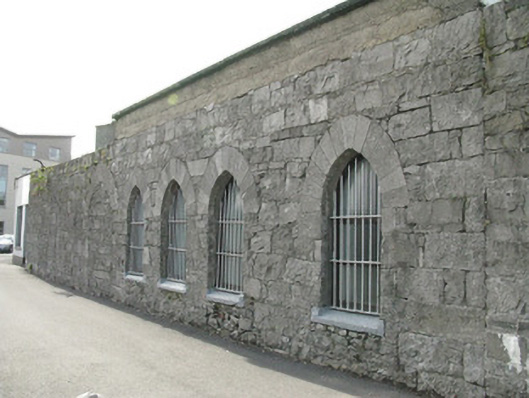 Forthill Graveyardgraveyard/cemetery · 275 yd
 Seán DugganMemorial · 407 yd
 City WallsHeritage attraction · 517 yd
 Padraic O'Conaire StatueMonument · 519 yd
 St. Augustines WellsHoly well · 564 yd
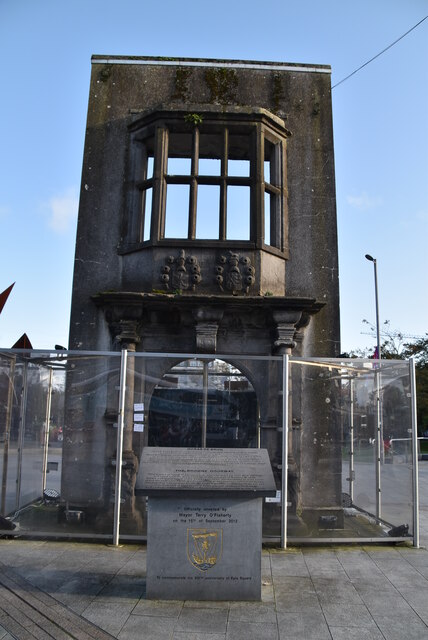 Browne DoorwayVisitor information · 571 yd
 Mechanics InstituteMemorial · 635 yd
 Lynch's CastleCastle · 674 yd
 Outset GalleryGallery · 691 yd
 Dead Mans BeachBeach / strand · 729 yd
Other information
Photo: National Inventory of Architectural Heritage · Website use allowed for educational or private purposes with source credit