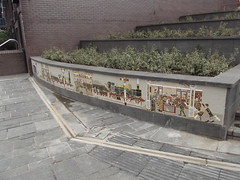
What is recorded here
This slate commemorative plaque records: A History of the Great Western Railway Construction of the Great Western Railway line to Snow Hill began in 1847. Isambard Kingdom Brunel was engineer in charge and the contractors were Peto and Betts. By 1852 the 129 mile track from Paddington via Oxford was complete - 7' 0" broad gauge to Oxford 4' 8½" narrow gauge from there to Birmingham with a third rail provided for the 7' 0" track. Narrow gauge became standard for the whole country in 1892. Signals were hand operated by railway police. The first Snow Hill station was opened on 1st October 1852. A special "Eve of Opening" train left Paddington pulled by Daniel Gooches "Lord of the Isles" which had been on show at the Great Exhibition. This was derailed at Aynho but successfully completed the journey the following day after a change in engine. Nine years later narrow gauge track was extended to Paddington providing a 3 hour 20 minute express service. Unheated carriages were lit by oil pot lamps and bar and disc signals were operated from trackside capstans. In 1871 a new station was built to accommodate the great increase in traffic. Expresses like No 162 "Cobham" designed by William Dean and driven by driver Hughes travelled direct from Paddington at average speeds of 52.7 MPH the maximum being 62.75 MPH. Carriages were of the clerestory type. Toilets were introduced in 1873. A familiar sight at the turn of the century was Dash the station dog. His collecting box strapped to his back. Signals were operated by Worcester levers at track level but by 1900 signal boxes became standard on main lines. Recorded plaque organisation: Budd Mosaics.
Isambard Kingdom Brunel, a renowned engineer, designed the Great Western Railway, known for its broad gauge tracks and innovative designs; Sir Samuel Morton Peto and Edward Betts were prominent contractors who oversaw the construction of the railway line to Snow Hill; Sir Daniel Gooch was an influential railway manager and director of the Great Western Railway, instrumental in its early success.
A plaque record does not grant entry to a building or private land. View it from a public place unless permission is clearly given.
Places near here
 Old Royal Public HouseListed building · 241 yd
 57 and 59, Church StreetListed building · 252 yd
 Burnaby obeliskMonument or public art · 258 yd
 Frederick Rowland EmettMemorial · 419 yd
 Birmingham Museum & Art GalleryMuseum · 490 yd
 63-64, Ludgate HillListed building · 374 yd
 Public Toilets Built Into Snowhill Railway Bridge Arch, Corner Livery Street and Lionel StreetListed building · 389 yd
 Snow Hill Bridge, BirminghamCanal bridge · 431 yd
 Four K6 Telephone Kiosks, Eden PlaceListed building · 444 yd
 School of Art, Birmingham City UniversityListed building · 450 yd
 Ludgate Hill BridgeCanal bridge · 477 yd
 21, Ludgate Hill B3Listed building · 479 yd
Other information
Photo: Elliott Brown · CC BY-SA 2.0