What is recorded here
An imperfect ring of limestone marks Noughaval, its uneven segments and small rounded armpits defying neat geometry. The cross stands within a graveyard beside a medieval church and chapel, probably dating to the 12th or early 13th century. Its western face holds faint circular traces that may have borne interlace decoration, while the eastern face remains blank. The shaft rises from a raised slab, suggesting the stone still serves the dead and the living memory of the place.
Within a graveyard (CL009-059024-) to the S of a medieval church (CL009-059023-) and to the W of a chapel (CL009-059027-). Noted by Westropp (1909, 25) a ‘curious Celtic cross’. Harbison (1992, vol. 1, 158) describes it as a ringed limestone cross (H above ground 1.18m; arm Wth 0.67m; T 0.1m) with traces of roll mouldings at the edges. The ring segments do not form a perfect circle and the armpits are small and rounded. Traces of a circular decoration at the centre of the head on the W face may have borne interlace decoration. There is another set of circles beneath it. The E face appears to be undecorated. The shaft of the cross is set in a hole in a raised slab of limestone, which forms the top of a leacht (CL009-059120-). The cross probably dates to the 12th or early 13th century (ibid.). (Large 2011)
The following image has been uploaded: CL009-059028-_01.jpg W face of cross
Compiled by: Olive Alcock and Conn Herriott
Date of upload: 30 March 2022
The cross in Noughaval was likely erected in the early medieval period, associated with the nearby church and chapel, and exhibits a Celtic style. It is significant as a rare surviving example of early Christian sculpture in the Burren region.
The monument record does not grant public access. Check the route and ask the landowner before entering private land.
- What survives
- Recorded monument
Places near here
 Noughaval Church (in ruins)Church · 19 yd
 Saint Mochua's Catholic Churchchurch/chapel · 70 yd
 Enclosure in KiltaanEnclosure · 205 yd
 Enclosure in Noughaval (burren By.)Enclosure · 207 yd
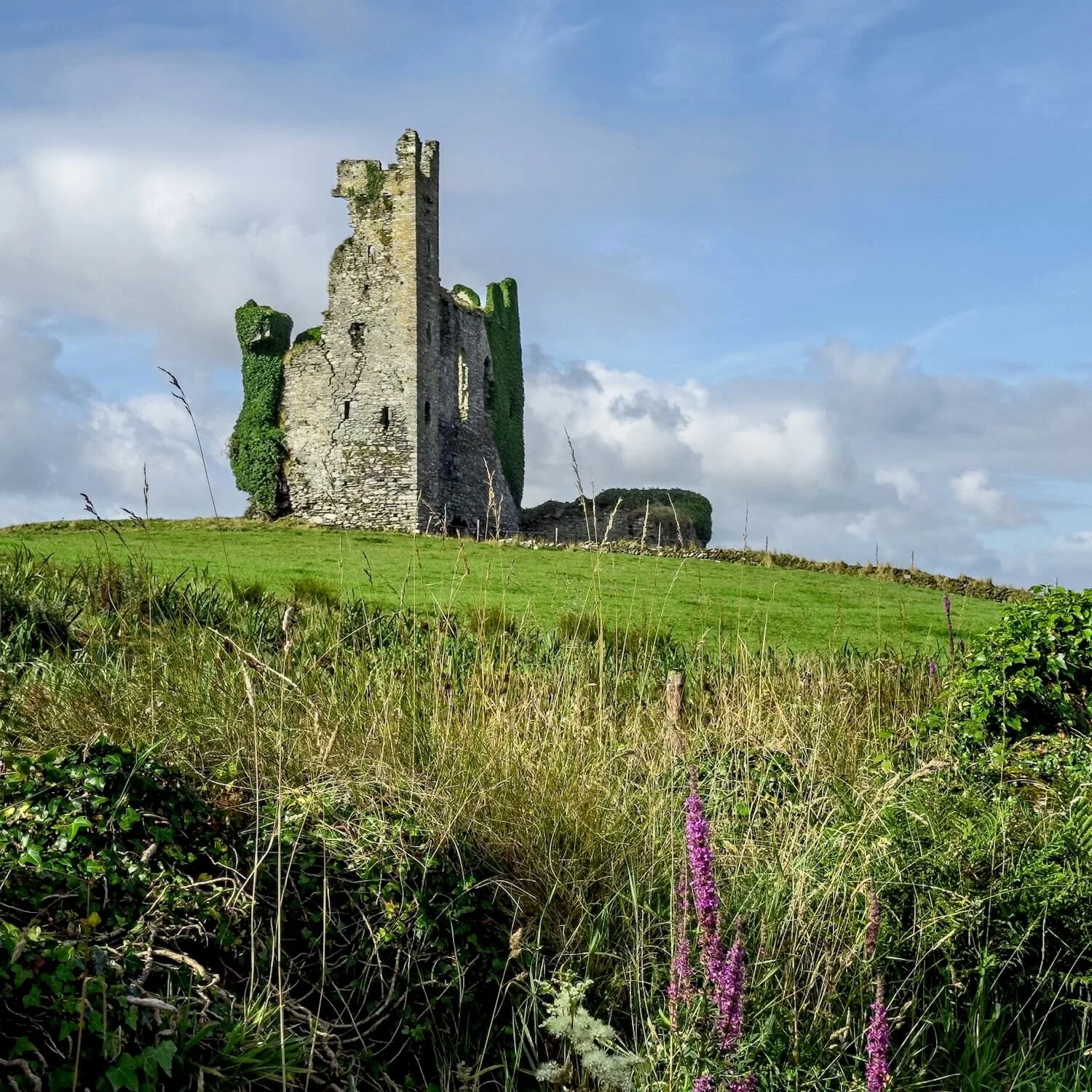 Site of Ballymurphy CastleCastle, tower house · 1684 yd
 Roughan Castle (Supposed Site of)Castle, unclassified · 1.1 mi
 Cave of the Wild HorsesCave · 1.8 mi
 Cahermacnaghten CashelHeritage attraction · 2.2 mi
 High CrossHeritage attraction · 2.3 mi
 Burren Centre KilfenoraVisitor information · 2.3 mi
 Cullaun 5 (C5b)Cave · 2.9 mi
 Ballyteigue Nature ReserveNature reserve · 3.6 mi