Overview
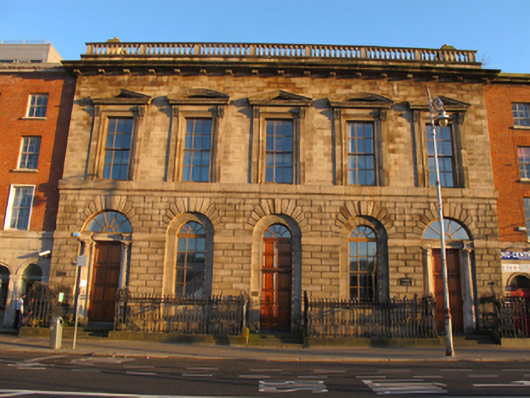
Corn Exchange — Burgh Quay is recorded as exchange/tholsel in Dublin. Attached five-bay two-storey over basement former corn exchange, built 1816-17, rebuilt 1998 to rear. Recent flat roof hidden behind granite balustraded parapet with rendered chimneystacks having clay pots.
Why it was built
The saved account records: Attached five-bay two-storey over basement former corn exchange, built 1816-17, rebuilt 1998 to rear.
People and work
The saved account records: Recent flat roof hidden behind granite balustraded parapet with rendered chimneystacks having clay pots.
How it changed
The saved account records: Carved cornice having modillions over ashlar granite to first floor, rusticated granite to ground floor, plinth course and rendered wall to basement.
What survives
The saved account records: Cast-iron railings on carved granite plinth wall, enclosing basement areas to front.
Why it mattered
Corn Exchange — Burgh Quay matters for the exact reasons given in its official assessment, rather than merely because it is an old structure. The source records: The Corn Exchange was built to designs by George Halpin of the Ballast Board and approved by the Wide Street Commission. Thomas Baker and Robert McCartney wereresponsible for the stonework. It originally consisted of a large hall which extended south to Poolbeg Street. It accommodated up to 130 traders, seed suppliers and millers dealing with corn landed at Dublin port, with ships docking directly outside the building, at Burgh Quay, up until the late nineteenth century, at which time the Loop Line Bridge was constructed which resulted in blocking access to the quay. As the corn-trading business diminished in… This explains what the place adds to local life, the street or the surviving built history.
History checked 15 August 2026 against the named sources below.
Add the human story, a picture, a first-hand message or a missing place.
Earn 5 points after the picture is checked and accepted.
Add a pictureAdd its storyTalk or ask a questionAdd a new placeThis official record and map point do not grant access. Most recorded buildings are privately owned; view them only from public ground unless the owner allows entry.
Conversation about this place
Questions and messages sit beneath the source record. They are checked before appearing.
No questions or messages yet.
Ask a question or join the conversation