What is recorded here
Cloghmacudda is a water-filled bullaun stone on the Castlemaine road, where people have paid rounds and washed their eyes in borrowed well water before dawn for centuries. The stone belongs to St. Carthage Mochaeda, stands beside the old Kiltallagh church, and still collects rags on a nearby tree as tokens of cure. Its hollow is not a hidden spring but a marked place where the body is remembered, touched, and returned lightened to the road.
On the SE side of the road leading to the NE from Castlemaine. This road forms the townland boundary between Meanus and Cloonalassan. The stone, known locally as a holy well, is embedded in concrete at ground level and displays a large, water-filled, bowl-shaped hollow (diam. 42cm; D 20cm) on its upper surface. A well-built stone wall (H 1.2m) surrounds the bullaun stone on three sides. According to Gerry Clifford, who lives nearby, there is no spring under the bullaun. It is sometimes referred to as the font and is in occasional use as a holy well. In 1871 it was recorded that the medieval church of Kiltallagh [KE047-029001-) 'stood where the Protestant church now stands. There are some stones of the old building scatter about the graveyard, and one in the immediate vicinity, hollowed in the shape of an inverted cone, around people pay rounds. This is called Cloch-Mochaeda [KE047-028001-], or the stone of St. Carthage Mochaeda' (Cusack 1871, 453).
Folklore collected from Castlemaine School about the 'The Old Church of Kiltallagh' recorded the following tradition; 'There is an old ruin of a church near my uncles house. There are three priests buried in the middle of the old ruin. On a dark Winters night big light is seen there. There is also a ruin of town to be seen. It is called Clounalassan. It is probably one of the forts owned by Fingen Macuda's father. Not very far from the ruin is a stone called the holy stone [KE047-028001-]. People come to this stone to get cured and leave rags on a tree [KE047-028002-] near it. People say if you took anyone of the rags in your hands you would get the disease the person had. This stone is called Cloc Moc[?] and is situated in the foot- path leading to the Rectory. The people come to this stone generally before dawn and bring a bottle of water from a well nearby. They then say three or four rosaries and wash their eyes in the water. Immediately they are cured and leave a rag or some other token on a tree near the stone as we have already mentioned' (The Schools’ Collection, Volume 0433, Page 034; https://www.duchas.ie/en/cbes/4687710/4686092).
See attached photographs courtesy of Amanda Clarke
Compiled by: Caimin O'Brien
Date of upload: 23 May 2022
Likely dating to the early Christian or medieval period, the stone may have been associated with a holy well and used for ritual or devotional purposes. Local tradition suggests it holds spiritual significance, possibly linked to folklore or saintly legends.
The monument record does not grant public access. Check the route and ask the landowner before entering private land.
- What survives
- Recorded monument
Places near here
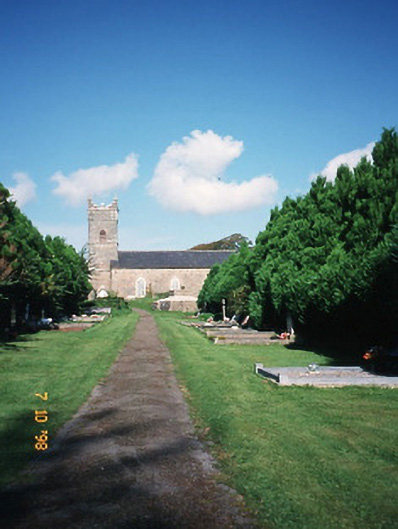 Saint Carthage's Church (Kiltallagh)church/chapel · 163 yd
 OutlinedEcclesiastical enclosure · 171 yd
 Ritual siteRitual site, holy tree/bush · 483 yd
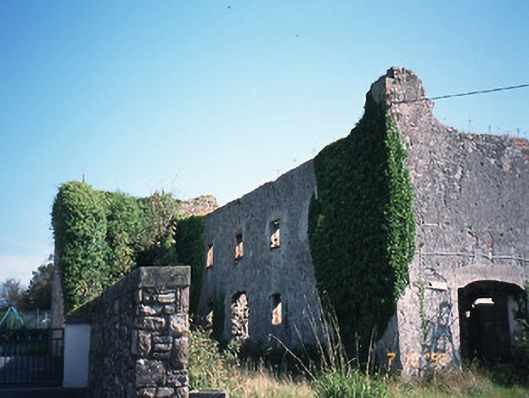 store/warehousestore/warehouse · 709 yd
 Site of Castle MaineCastle, Anglo-Norman masonry castle · 1039 yd
 CastleCastle, tower house · 2.1 mi
 Ballygamboon Forest Recreation AreaWood · 2.4 mi
 KnockmoyleMountain / peak · 3.0 mi
 Scotia's GraveArchaeological place · 3.8 mi
 LisnagraveArchaeological place · 3.9 mi
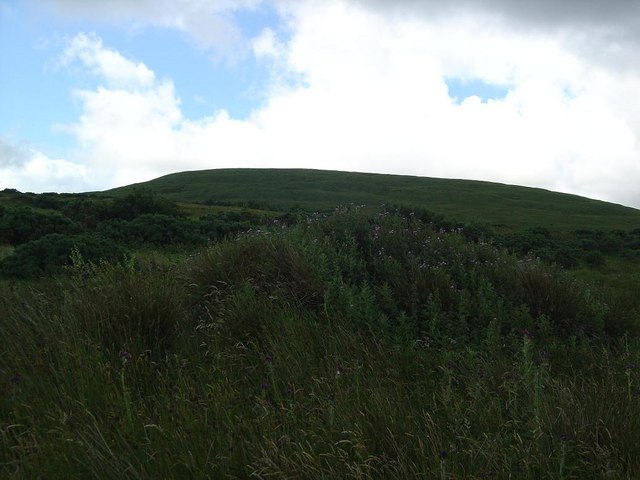 Knockmichael MountainMountain / peak · 4.0 mi
 The Kerry Creamery ExperienceHeritage attraction · 4.2 mi